These small group Bible studies of Acts 13 contain commentary, discussion questions, and practical application. Visit our library of inductive Bible studies for more in depth inductive studies on this and other books of the Bible you can use in your small group.
Acts 13 – Paul and Barnabas Commissioned
Acts 13 Bible Study Video
Acts 13 Podcast
Outline
I. Barnabas and Saul commissioned (1-3)
II. The gospel opposed but advancing (4-12)
I. Barnabas and Saul commissioned (1-3)
Discussion Questions
• What were the church leaders doing when they heard from the Holy Spirit?
• What principles can we learn from this?
• Do you think the Holy Spirit spoke to them audibly? Why or why not?
• When does the Holy Spirit normally speak to you? How?
• How do you discern the Holy Spirit’s voice from others?
• What is the significance of the laying on of hands?
• Is it important for missionaries to have a sending or commissioning group standing behind them? Why or why not?
• What are some of the benefits of public commissioning of leaders or missionaries?
• What are the potential risks of a person going as a missionary without backing or support?
Cross-References
2 Timothy 1:6 – For this reason I remind you to fan into flame the gift of God, which is in you through the laying on of my hands.
Acts 6:5-6 – And what they said pleased the whole gathering, and they chose Stephen, a man full of faith and of the Holy Spirit, and Philip, and Prochorus, and Nicanor, and Timon, and Parmenas, and Nicolaus, a proselyte of Antioch. These they set before the apostles, and they prayed and laid their hands on them.
Numbers 27:18-20 – So the Lord said to Moses, “Take Joshua the son of Nun, a man in whom is the Spirit, and lay your hand on him. Make him stand before Eleazar the priest and all the congregation, and you shall commission him in their sight. You shall invest him with some of your authority, that all the congregation of the people of Israel may obey.
Daniel 10:2-3 – In those days I, Daniel, was mourning for three weeks. I ate no delicacies, no meat or wine entered my mouth, nor did I anoint myself at all, for the full three weeks.
Verse by Verse Commentary
1. The leaders were worshiping and fasting when the Holy Spirit spoke to them –
Acts 13:1-2 – Now there were in the church at Antioch prophets and teachers, Barnabas, Simeon who was called Niger, Lucius of Cyrene, Manaen a lifelong friend of Herod the tetrarch, and Saul. While they were worshiping the Lord and fasting, the Holy Spirit said…
Do you want to find God? Do you want Him to speak to you? This passage tells us how we can help make that happen.
I have never heard a missionary say, “I was eating Pringles and watching a football game and God told me I should move to the Amazon and become a missionary.” It is possible this could happen but not likely. Most of the time we find God when we are seeking Him.
The church leaders were worshiping the Lord and fasting. They were actively seeking His will. Because they sought the Lord, He answered.
Jeremiah 29:13 – You will seek me and find me, when you seek me with all your heart.
He is there. He is waiting. He wants to have a deeper relationship with us. He wants to guide us.
Sadly, many people these days spend copious amounts of time on media. We have trained ourselves to never have a dull moment. People want to be stimulated and despise boredom. Commutes that used to be done in silence can now be spent listening to podcasts or even watching video clips. My children ask to watch YouTube clips while doing their chores. Many prefer to be entertained than to think deeply. Many outlets provide an escape for people to turn off their brains and many eagerly take it.
You can learn a lot about the world we live in by looking at what kinds of videos get the most views. Videos of people staring at a clock, eating water with chopsticks, and a chip rotating get millions of views while hour-long Bible study videos get ignored.
C.S. Lewis wrote about this already decades ago in the Screwtape Letters. In this book, an “uncle” demon is mentoring his nephew. He is teaching him the best ways to tempt people. One section is about how he tempted his “patient.” The man was in the London Museum and he started to think about the question, “Is this all that man has accomplished in thousands of years?”
The demon was worried that this line of thinking would cause the man to go deeper in thought about the meaning of life and where we came from. So he tempted him, not with any great philosophical thought. Just with a bacon sandwich. A picture of a bacon sandwich entered into the man’s mind. And he thought about lunch. Lunch would be tasty. There was a nice restaurant not far away. He could go and have lunch and think about these things later. Always later. That is the goal.
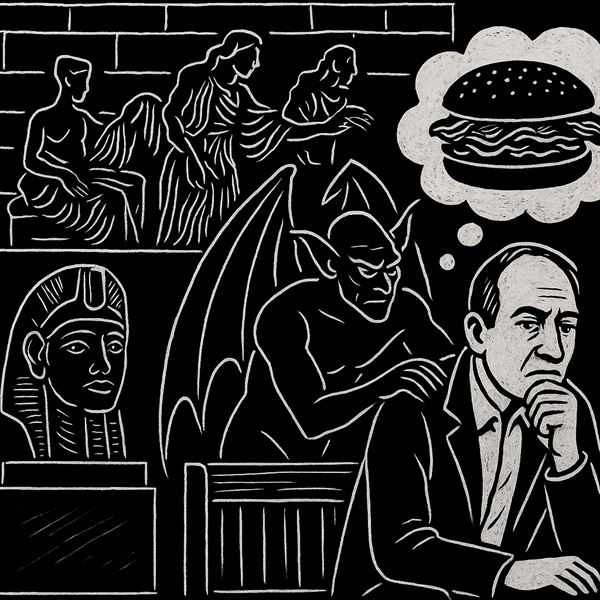
The enemy wants us to pray later. Have lunch first. Have a rest. Relax. Don’t think too deeply.
If you want to find God, you need to seek Him. Prayer, worship, and fasting are key ways to seek God.
Application – How will you seek God this week more than the last?
If you want to know God’s will for your life, follow Him and you will find it as you walk.
Reflect – When does the Holy Spirit normally speak to you? How?
2. Saul and Barnabas Commissioned –
Acts 13:2-3 – “Set apart for me Barnabas and Saul for the work to which I have called them.” Then after fasting and praying they laid their hands on them and sent them off.
As they were fasting and seeking God, He answered. The Holy Spirit told them to set apart Barnabas and Saul for His work. We don’t know if this was communicated to them audibly or rather through a group consensus and strong conviction in their hearts.
I have worked with a deacon and elder time where as a group we felt clearly the Holy Spirit’s call to take a specific action. Sometimes that was confirmed through the testimonies of multiple different members who came to the same thought, often through the Scriptures, independently. As we heard one person after another share what God had spoken to them, we realized God was leading us as a whole group.
However God worked, it was clear to them that He was leading them to commission Barnabas and Saul.
Reflect – What are some of the benefits of public commissioning of leaders or missionaries?
Public commissioning of missionaries and leaders is important for many reasons.
• It gives confidence and assurance to the sent individuals that they are in God’s will. It is a tangible and public confirmation of the invisible work of God in their lives.
• It continues to give that confidence and assurance moving forward as sent individuals can look back and remember clearly how their calling was supported by the church as a whole.
• It gives a certain amount of accountability as the sent or commissioned individuals are then to some extent answerable to those commissioning them.
• It encourages the church at large to pray for, support, and encourage those who are sent.
• It reminds all involved that the mission is a team effort and that needs continued cooperation between the sending and the sent.
• It strengthens church unity.
• It brings glory to God because He is the author of the whole event. He is the how and the why.
• It reminds the sent to be humble and depend on God’s power (Galatians 3:3, Philippians 1:6).
• It teaches the congregation about the importance of missions or church leadership.
Reflect – What are the potential risks of a person going as a missionary without backing or support?
A leader, minister, or missionary who is not commissioned faces some possible dangers.
• Little or no accountability.
• Less prayer support.
• More self-dependence.
• Potentially less financial support and member care.
• Possible questioning or doubt about their calling which could lead to compromise or giving up.
• Loneliness and isolation.
• Fewer opportunities to receive counsel.
Application – Your church has likely commissioned missionaries and leaders. Do you actively support and pray for them? Reflect on this and write down one way you can support one person your church has commissioned, laid hands on, or set apart for ministry.
II. The gospel opposed but advancing (4-12)
Discussion Questions
• Who sent Barnabas and Saul? Why is that important?
• Where did they go to first when they arrived at their destination?
• Why did they normally start preaching at synagogues first?
• What types of problems and opposition did they run into?
• What does the opposition they experienced teach us about Satan and his work?
• What may have motivated Elymas the magician to oppose them?
• What is magic? Is magic evil?
• Is it OK to go watch a performance by a magician?
• How did Paul respond to the opposition they faced?
• Was he too harsh?
• What can we learn from Paul’s response?
• Should we deal with opposition in the same way that he did?
• What was the result of the miracle that Paul did?
• How is God’s power different than magic?
• How is God’s power different than Satan’s?
Cross-References
Acts 9:15 – But the Lord said to him, “Go, for he is a chosen instrument of mine to carry my name before the Gentiles and kings and the children of Israel.
1 Corinthians 4:9 – For I think that God has exhibited us apostles as last of all, like men sentenced to death, because we have become a spectacle to the world, to angels, and to men.
Acts 9:20, 13:14, 14:1, 17:1-2, 18:4, 22:19-21 – In these verses we see Paul’s habit of going to synagogues first to preach the gospel.
Verse by Verse Commentary
1. Salamis –
The first stop on Paul’s first missionary journey was Salamis. This was a prominent city on the eastern coast of Cyprus. Cyprus was a large island off of the southern coast of the province of Asia Minor, modern-day Turkey.
2. Synagogues –
Acts 13:5 – When they arrived at Salamis, they proclaimed the word of God in the synagogues of the Jews.
When Paul went to a new city, he generally first went to synagogues to preach the gospel. Paul was a Jew and people who went to synagogues (other Jews) were closer culturally, linguistically, and in religious background than the other citizens at large. They shared a common faith in God as well as a common foundation in the Old Testament.
Synagogues also offered an open and public venue for exchanging ideas. While it wasn’t totally free for any visitor to stand up and speak, it was common for the local synagogue leaders to give invitations to speak to visiting visitors (Acts 13:15). Traveling rabbis and teachers would often have opportunities to speak. It would have been relatively rare for educated teachers to travel all the way from Jerusalem so when one came it was customary for synagogues to receive them and allow them to share. Thus there was a certain openness that Paul understood and used as a springboard to sharing the gospel in new places.
Synagogues also would sometimes have public debates where adherents to different viewpoints would have opportunities to engage in discourse and reason with each other (Acts 17:17).
Sometimes these synagogue discussions Paul took part in turned into mobs when his message was not well received (Acts 13:44-52, 14:2, 17:5, 18:5-6).
Reflect – Since Paul knew that sharing in the synagogue might provoke strong opposition, and even persecution, why did he keep doing it?
While mobs often developed, the seed of the gospel was sown and many people in these same locations turned to Christ (Acts 13:42. 48, 14:1, 17:4, 12). It was an opportunity to quickly share the gospel with large numbers of people in a new place. As is always the case, some received it and some rejected it.
Reflect – Where would be a good location to share the gospel in your country today?
3. Opposition from Elymas the magician –
The proconsul was favorable to the gospel and wanted to hear from Paul. This was significant because a proconsul was appointed by the Roman Senate as governor of a province, generally a more stable province without the need for troops.
However, where God is working we can often see Satan working as well.
Acts 13:6-8 – When they had gone through the whole island as far as Paphos, they came upon a certain magician, a Jewish false prophet named Bar-Jesus. He was with the proconsul, Sergius Paulus, a man of intelligence, who summoned Barnabas and Saul and sought to hear the word of God. But Elymas the magician (for that is the meaning of his name) opposed them, seeking to turn the proconsul away from the faith.
God often uses people to accomplish His plans. Satan is the master imitator and frequently does the same. In this case, his pawn is Elymas the magician. He is also described as a false prophet named Bar-Jesus. The name “Bar-Jesus” means “Son of Jesus,” literally “Son of Yeshua.” He had a spiritual-sounding name but was opposed to Christ. Satan appears as an angel of light. Not everyone claiming to be a prophet or a follower of Christ is. We need spiritual discernment.
The name “Elymas” is likely a title that may mean “wise” or “sorcerer.”
The word used for magician here in Acts 13 is similar to the one used for Simon in Acts 8. In this passage, the noun form “magos” is used while in Acts 8, the verb form “mageuo” is used.
Here are my notes on magicians at the time from Acts 8.
The Greek word describing Elymas as a magician can be translated as magic or sorcery.
The word is related to the word in the Old Testament that we translate as “magi.” This was a class of people who were astronomers and scientists.
Wizards and sorcerers sometimes took this title as well. Was Simon’s and Elymas’ power real or fake? It was likely some of both. Elymas likely had some ability in illusion, deception, and tricking people. Most magicians nowadays are very good at tricks and illusions.
However, we also know that Satan and his demons have supernatural powers. Their power is nothing compared to God’s, but it is beyond our own.
The priests who opposed Moses appear to have also practiced the black arts (Exodus 7:22). Those sorcerers used power from Satan to mimic some of God’s miracles. But finally, they gave up the contest, admitting that they were no match for God and that His power was real.
Exodus 8:19 -Then the magicians said to Pharaoh, “This is the finger of God.”
Therefore, the best conclusion is that Elymas, like Simon, was in league with Satan and channeled demonic power in order to deceive the people and gain a reputation. Many people today still get involved in the occult.
Reflect– Why did Elymas oppose them? What did he seek to gain?
We do not know precisely Elymas’ opposition, but we can make some educated guesses.
• Elymas was a pawn of Satan and Satan used him to oppose the gospel taking root in a new location.
• Elymas was worried that he would lose his followers and fans to a new movement.
• Along with a loss of followers and fame, would come a financial loss.
Reflect – Share about a time when you faced opposition while serving God.
Application – Expect opposition. Do not be discouraged when it comes. Redouble your prayers because they are one of the best weapons we have to fight the spiritual battles we face.
4. Saul who was called Paul –
Acts 13:9 – But Saul, who was also called Paul.
This is the first use of the name Paul in Scripture. I am happy we have arrived because it was very difficult to keep using the name “Saul” instead of “Paul” over these past few chapters. The name “Paul” means “small” or “humble.” It may not be that Paul received a new name. Many people had dual names, one for use in one language/culture and one for use in another. Saul was his Hebrew name and Paul was his Roman name. Now that he was ministering among the Gentiles, he used his Roman name more often. This shows a subtle shift in the book of Acts from the Jews to the Gentiles.
5. Paul rebukes Elymas and blinds him –
Acts 13:9-11 – Paul, filled with the Holy Spirit, looked intently at him and said, “You son of the devil, you enemy of all righteousness, full of all deceit and villainy, will you not stop making crooked the straight paths of the Lord? And now, behold, the hand of the Lord is upon you, and you will be blind and unable to see the sun for a time.” Immediately mist and darkness fell upon him, and he went about seeking people to lead him by the hand.
There is no timidity here. Neither did Paul candy-coat his words or worry about politeness. He called Elymas out loud and clear as the snake that he was.
Why did do this and so publicly?
Elymas was a chess piece being used by Satan to oppose the gospel. Elymas must have had followers. In addition to his followers, there would have been people who were “on the fence” and undecided. Paul sought to publicly prove that Jesus was superior to whatever else was being peddled.
This public showdown is quite similar to what Elijah did with the challenge to Baal’s prophets in 1 Kings 17.
Both leaders sought to prove that God was true, almighty, and worthy to be followed over all other gods. In both cases, extreme action was necessary. Souls were at stake. People’s eternal destinies were on the line.
Here in Acts, the gospel was entering a new location where it was unknown. A powerful, public sign gave credibility to Paul and Barnabas and the gospel message. It showed all the crowds watching that Jesus was not only real but more powerful than anything or anyone they followed.
Application – There is a time to be quiet, polite, and respectful. And there is a time to issue a harsh rebuke or take a strong, public step of faith. Let us pray for wisdom to discern which is which and for boldness to take that step of faith when God calls us to.
6. The proconsul believed –
Acts 13:12 – Then the proconsul believed, when he saw what had occurred, for he was astonished at the teaching of the Lord.
Because Paul was courageous enough to take that public stand in faith, God’s kingdom won a major victory over Satan. The gospel advanced.
The proconsul was the governor of the entire island of Cyprus. Since he believed in Jesus, the island would have the doors for the gospel flung wide open.
The Holy Spirit’s tactics overcame Satan, again.
Paul and Barnabas were also faithful to carry out their part. Many believers might have been intimidated to share with such a powerful man as the proconsul. If he rejected their message, how might he respond? God opened a door and they faithfully went through.
Reflect – Have you ever failed to go through a door God opened for the gospel? What kept you back from boldly speaking out?
Acts eBook Study – If enjoy this study, you can download the full digital eBook from our store.
Acts Paperback Study – Or you can get the physical Paperback from Amazon.
Turning the World Upside Down - Acts Study
Get weekly Acts Bible studies with teaching, application, and questions plus future Bible study resources by email.
 Meet the Author: Jason Dexter has been serving the Lord overseas in the 10/40 Window for more than twenty years, making disciples, teaching the Bible, and equipping believers to understand and apply God’s Word. These Bible studies were written by him, not by AI.
We want to help you study the Bible, obey the Bible, and teach the Bible to others. We have therefore created a library of almost one thousand (and growing) inductive Bible studies, which are available for free.



Leave A Comment